
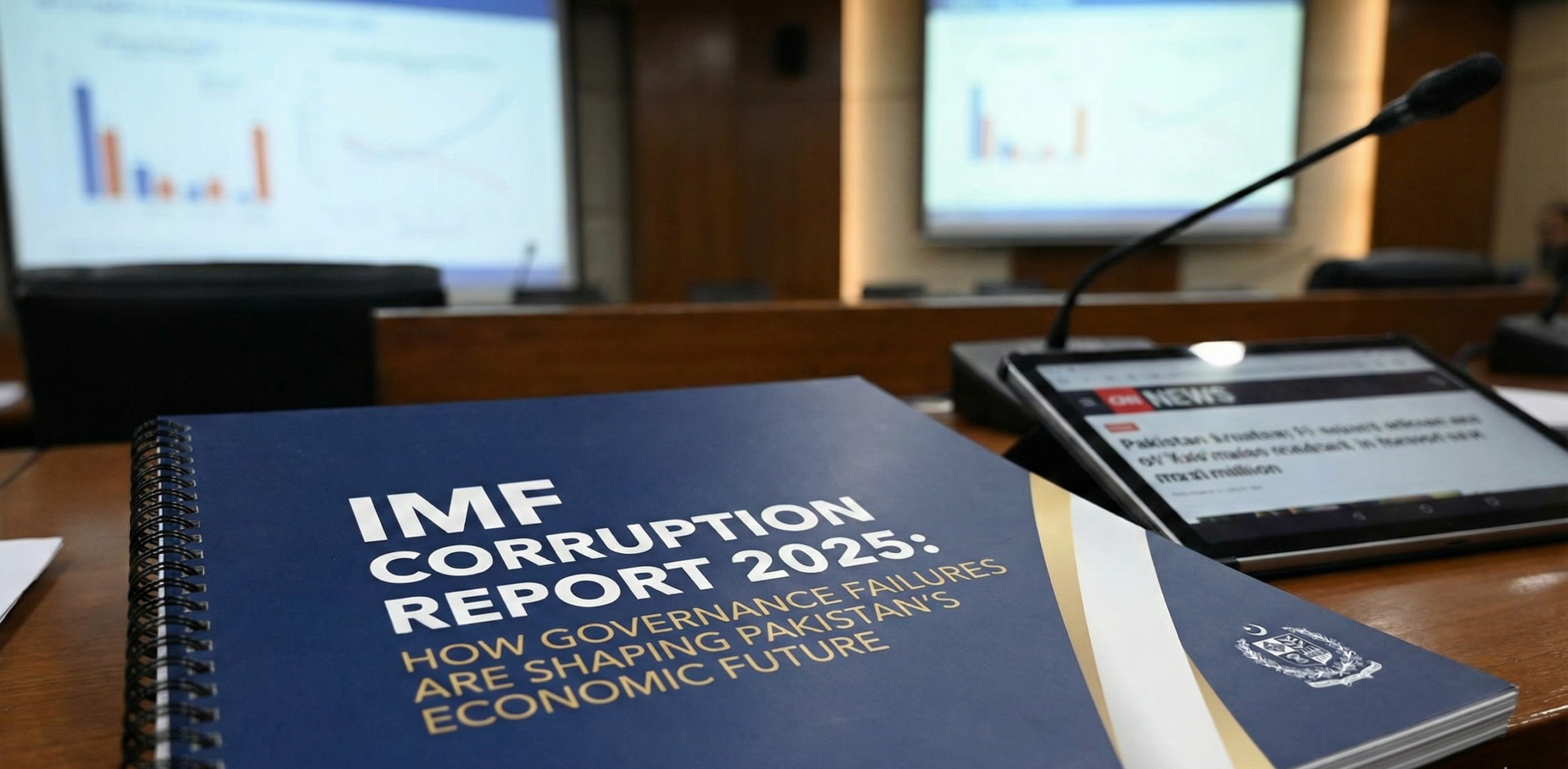
In November 2025, the International Monetary Fund (IMF) released a landmark document titled “Pakistan: Governance and Corruption Diagnostic Report”, widely referenced as the IMF Corruption Report 2025, prepared at the request of the Government of Pakistan. The report presents an unfiltered, data-backed evaluation of Pakistan’s governance system, institutional weaknesses, and the massive economic cost of widespread corruption.
This technical assistance report is part of the IMF’s broader Framework for Enhanced Fund Engagement on Governance — a framework used only for countries where corruption poses a direct threat to macroeconomic stability. Pakistan voluntarily sought this diagnostic, acknowledging that entrenched corruption is undermining the country’s growth, investment climate, and public trust.
With Pakistan facing recurring economic crises, high inflation, and a growing debt burden, this report arrives at a critical moment. It not only highlights the causes behind Pakistan’s persistent economic instability but also outlines structural reforms necessary for long-term recovery.
What the IMF Corruption Report Is About — A Quick Overview
According to the IMF’s diagnostic, the assessment focused on corruption vulnerabilities across five core state functions:
- Fiscal governance
- Market regulation
- Financial sector oversight
- Anti-money laundering and combating terrorism financing (AML/CFT)
- Rule of law
To compile this report, IMF and World Bank experts conducted field missions, interviewed government bodies, civil society, judiciary members, private sector stakeholders, and regulatory institutions.
The conclusion is blunt: corruption in Pakistan is systemic, persistent, and deeply rooted in the country’s governance structure. It is a major driver behind low investment, slow growth, and repeated macroeconomic crises.
Key Findings of the IMF Corruption Report
1. Pakistan Has a “State-Dominated Economy” Vulnerable to Rent-Seeking
The report highlights that Pakistan’s economy is heavily controlled by the state, with large public-sector enterprises, unclear regulatory boundaries, and overlapping mandates.
- This environment creates perfect conditions for:
- political favoritism
- elite capture
- unjustified government interventions
- preferential treatment for connected firms
According to Al Jazeera’s coverage, Pakistan loses nearly 6% of its GDP to elite capture and corruption — one of the highest economic losses in Asia.
2. Complex Tax System With Weak Controls Enables Corruption
The IMF finds Pakistan’s tax system unnecessarily complicated, opaque, and riddled with discretionary powers. Issues identified:
- FBR has excessive authority with limited oversight
- Customs administration is porous
- Tax-to-GDP ratio remains among the lowest in the region
- Widespread leakages and discretionary exemptions
This not only reduces revenue but also erodes public confidence.
3. Regulatory Bodies Lack Independence & Are Vulnerable to Political Interference
IMF notes that Pakistan’s regulators — across energy, competition, finance, commerce, and markets — often operate without meaningful independence. Result:
- inconsistent enforcement
- unpredictable business climate
- policies tailored for the powerful
The Tribune’s analysis calls this a “statist model” that stifles innovation, efficiency, and competition.
4. Weak Rule of Law and a Struggling Judicial System
The IMF identifies Pakistan’s judicial system as one of the biggest bottlenecks in governance reform. Major Issues:
- severe delays in resolving commercial disputes
- low trust in judiciary
- fragmented and outdated legal frameworks
- political interference risks
Because property rights are weakly protected, investors—local and foreign—prefer safer markets like UAE, Bangladesh, and Vietnam.
5. Anti-Corruption Agencies Lack Independence & Coordination
Institutions like:
- Provincial Anti-Corruption Establishments
- National Accountability Bureau (NAB)
- Federal Investigation Agency (FIA)
suffer from:
- limited capacities
- political misuse
- fragmented authority
- weak preventive strategies
- inefficient investigation processes
Dawn’s coverage notes that Pakistan’s accountability system has historically been weaponized, not institutionalized — harming credibility.
Impact of Corruption on Pakistan’s Economy
The Times of India summarized the report as stating corruption is “corrosive” and a direct reason for Pakistan’s financial crisis. Based on IMF findings and news analysis, corruption impacts Pakistan in four major ways:
1. Flight of Investment
Unpredictable rules discourage domestic and foreign investors.
2. High Cost of Doing Business
Regulatory red tape, bribery, and favoritism increase business expenses.
3. Chronic Fiscal Deficits
Fraud, leakages, and misuse of public money worsen Pakistan’s debt burden.
4. Slow Private Sector Growth
State monopolies and politically connected groups dominate markets.
IMF’s Recommendations: What Pakistan Must Do
The IMF provides a comprehensive list of reforms, but the top priorities include:
1. Tax System Reform
- Create a dedicated tax policy office
- Simplify tax structure
- Strengthen internal audits in revenue authorities
- Establish an independent internal affairs unit for FBR
2. Strengthen Public Financial Management
- Reduce supplementary grants
- Improve procurement transparency
- Reform budget forecasting
- Improve oversight of SOEs
3. Improve Regulatory Framework
- Digitize compliance processes
- Increase transparency
- Ensure independence of regulators
- Reduce unnecessary state intervention
4. Strengthen Rule of Law
- Modernize outdated laws
- Reduce court backlogs
- Reform judicial appointment and oversight
- Increase transparency in court performance
5. Enhance Anti-Corruption Institutions
- Focus on prevention, not just prosecution
- Publish asset declarations
- Improve selection process of leadership
- Improve inter-agency coordination
- Strengthen AML/CFT systems for corruption-related risks
What This Means for Pakistan’s Future
The IMF makes it clear: Pakistan cannot achieve sustainable economic stability without addressing corruption at the structural and institutional level.
The state-heavy, opaque, and fragmented governance model has reached its limit. Without reform:
- investment will remain low
- debt will continue rising
- economic crises will occur more frequently
- public trust will deteriorate further
However, if the government acts on the IMF’s recommendations, Pakistan can achieve:
- higher foreign investment
- better tax revenue
- stronger institutions
- increased economic confidence
- long-term growth
- transparent governance
The IMF calls for “visible and concrete progress” in governance reforms — not cosmetic or temporary fixes. Pakistan’s future economic stability depends entirely on how sincerely and consistently these reforms are implemented. While the next IMF program may help stabilize Pakistan’s economy in the short term, long-term sustainability will only be possible if the country genuinely addresses the structural issues highlighted in the IMF’s Corruption Report 2025.
Conclusion
The IMF’s 2025 Corruption Diagnostic Report is a wake-up call for Pakistan. It lays out, with evidence and clarity, how corruption, weak institutions, and elite capture have crippled the country’s economy for decades. But it also offers a clear roadmap toward recovery.
If Pakistan embraces institutional reform — not just temporary measures — it can restore investor confidence, stabilize the economy, and rebuild public trust. The choice is now in the hands of policymakers, institutions, and the political leadership.