
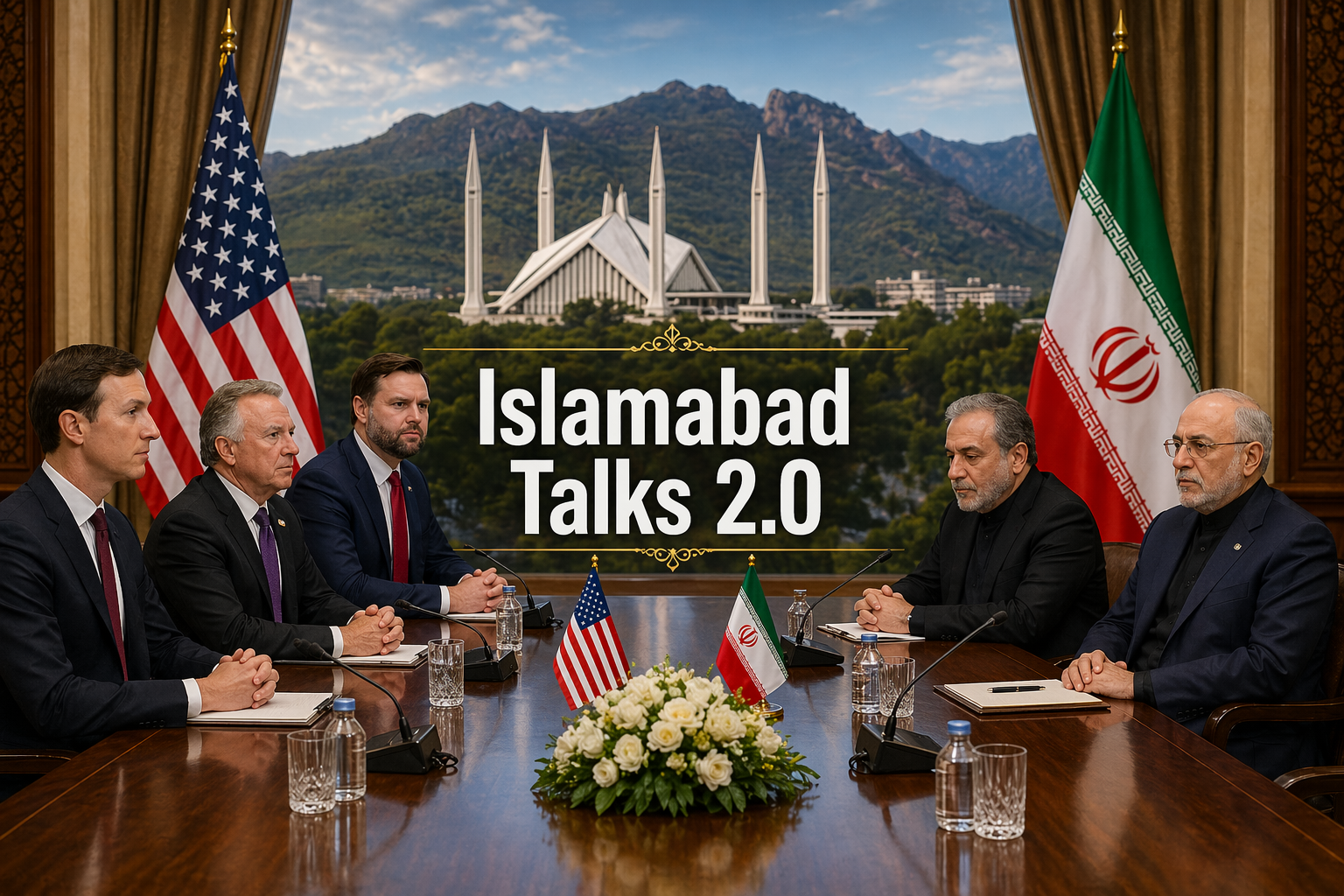
The world is closely watching Pakistan as it prepares to host one of the most critical diplomatic events of 2026 — Islamabad Talks 2.0. These talks, expected to bring together the United States and Iran, aim to reduce escalating tensions and possibly reshape the geopolitical landscape of the Middle East.
But a major question remains:
👉 Will Islamabad Talks 2.0 actually happen — or are they on the brink of collapse?
With mixed signals from Washington and Tehran, and Pakistan caught in the middle as a mediator, the situation is rapidly evolving. In this article, we break down the latest developments, challenges, and what it all means for Pakistan and the world.
What Are Islamabad Talks 2.0?
Islamabad Talks 2.0 refers to the second round of peace negotiations between the United States and Iran, hosted in Pakistan’s capital.
The primary goals include:
- Reducing tensions between Iran and Israel
- Addressing the Strait of Hormuz security crisis
- Negotiating Iran’s nuclear program limitations
- Preventing a broader regional conflict
The first round of talks ended without a breakthrough, but both sides signaled willingness to continue discussions — leading to the proposed second round.
A Look Back: What Happened in the First Round (April 11–12)?
Before diving into the uncertainty surrounding Islamabad Talks 2.0, it’s important to understand what happened during the first round of Islamabad Talks held on April 11–12, 2026.
The initial round marked a rare moment of direct engagement between the United States and Iran, facilitated by Pakistan as a neutral host. While the talks did not produce a formal agreement, they were considered a significant diplomatic step forward, as both sides agreed to continue dialogue rather than escalate conflict. Key issues discussed included regional security, nuclear concerns, and maritime tensions, but deep-rooted disagreements prevented a breakthrough. Still, the talks helped establish communication channels and created cautious optimism — laying the groundwork for what is now being called Islamabad Talks 2.0.
Current Status: Talks in Limbo
As of now, Islamabad Talks 2.0 are uncertain and delayed.
Pakistan has officially stated that it is:
➡️ Waiting for a formal response from Iran before confirming the next round.
Iran, however, has not committed yet. The main reason? A growing list of disagreements with the United States — especially regarding military actions and economic pressure.
According to reports, Tehran is reluctant to participate unless certain conditions are met, particularly:
- Ending the US naval blockade
- Ensuring fair negotiation terms
Iran has clearly indicated that it sees the blockade as a violation of the ceasefire agreement.
Conflicting Signals from the United States
US President Donald Trump has added further uncertainty to the situation.
On one hand:
- He hinted that “good news” could come within 36–72 hours
- Suggested talks might resume soon
On the other hand:
- The US continues its naval blockade on Iran
- Maintains a strong military stance in the region
Trump even claimed that Iran is under financial pressure and may be forced to negotiate soon, stating the country is “losing $500 million a day.”
However, Iranian officials have strongly rejected these claims, calling them propaganda and reaffirming internal unity.
This contradiction between diplomacy and pressure is one of the biggest reasons the talks are currently stuck.
Key Issue: The Strait of Hormuz Crisis
One of the central topics of Islamabad Talks 2.0 is the Strait of Hormuz, a critical global oil route. Recent developments include:
- Iranian forces allegedly seizing vessels
- Attacks on cargo ships
- Rising maritime insecurity
These actions have:
- Increased global oil market concerns
- Heightened military tensions
- Made negotiations more urgent — yet more complicated
The US wants:
➡️ Free and secure navigation
Iran demands:
➡️ Respect for its sovereignty and removal of restrictions
Until this issue is resolved, progress in talks remains difficult.
Pakistan’s Role: A Rising Diplomatic Power
Pakistan’s involvement in these talks is highly significant.
For years, Pakistan has been seen as a strategic but underutilized diplomatic player. Hosting Islamabad Talks 2.0 could change that narrative.
Pakistan is:
- Acting as a neutral mediator
- Maintaining relations with both the US and Iran
- Providing a secure platform for dialogue
Foreign Minister Ishaq Dar has been actively engaging with international counterparts, emphasizing the importance of diplomacy.
If successful, these talks could:
- Boost Pakistan’s global image
- Strengthen its geopolitical influence
- Position Islamabad as a hub for international diplomacy
As one analysis noted, Pakistan hopes to “reframe its international image” through these historic negotiations.
Security Situation in Islamabad
The anticipation of Islamabad Talks 2.0 has already transformed the city.
Reports indicate:
- Heavy deployment of security forces
- Road closures across Islamabad
- Restricted access to key areas
- Hotels under strict surveillance
In fact, daily life in the capital has been disrupted:
- Schools closed
- Markets affected
- Citizens advised to work from home
The city is essentially on standby, waiting for the talks to begin.
This level of preparation highlights the importance and sensitivity of the event.
Major Challenges Facing the Talks
Several key obstacles are preventing Islamabad Talks 2.0 from moving forward:
1. Lack of Trust Between US and Iran
Both countries accuse each other of violating agreements and spreading misinformation.
2. Naval Blockade Dispute
Iran refuses to negotiate unless the blockade is lifted.
3. Military Tensions
Recent incidents in the Strait of Hormuz have escalated the situation.
4. Political Pressure
Domestic politics in both countries make compromise difficult.
5. Unclear Timeline
There is no confirmed date for the talks — only speculation.
Is There Still Hope?
Despite the uncertainty, there are signs of cautious optimism.
- The ceasefire has been extended
- Backchannel communication continues
- Both sides have not completely walked away
Trump’s statement about a possible breakthrough and Iran’s openness to “fair negotiations” suggest that diplomacy is still alive — though fragile.
Experts believe that:
👉 If even a partial agreement is reached, it could pave the way for long-term peace efforts.
What Happens If Talks Fail?
If Islamabad Talks 2.0 do not take place, the consequences could be serious:
- Increased risk of military conflict
- Disruption in global oil supply
- Economic instability worldwide
- Further polarization in the Middle East
For Pakistan, it would mean a missed opportunity to shine diplomatically.
Potential Outcomes if Talks Succeed
On the other hand, if the talks happen and succeed:
- A framework peace agreement could be established
- The Strait of Hormuz crisis could ease
- Iran-US relations may improve
- Pakistan’s global standing would significantly rise
There are even reports suggesting that a successful outcome could lead to a high-profile visit by US leadership to Pakistan, highlighting the importance of these negotiations.
Final Verdict: Will Islamabad Talks 2.0 Happen?
So, will Islamabad Talks 2.0 actually happen?
👉 Short Answer: Uncertain — but still possible.
The talks are currently in a state of limbo, with:
- Pakistan waiting
- Iran hesitant
- The US sending mixed signals
However, the fact that:
- Communication channels remain open
- Ceasefire is still holding
- Both sides express conditional willingness
…means the door to diplomacy is not closed yet.
Conclusion
Islamabad Talks 2.0 represent more than just a diplomatic meeting — they are a test of global leadership, trust, and conflict resolution.
For Pakistan, this is a defining moment.
For the world, it is a chance to avoid further escalation in an already volatile region.
Whether the talks happen or not, one thing is clear:
👉 Islamabad is now at the center of global diplomacy — and the world is watching.